
Last updated September 21, 2026
Full 25-point door and opener safety check with every visit - springs, cables, rollers, tracks, and your LiftMaster or Chamberlain opener included
You get a price before we start. It does not change when the truck arrives.

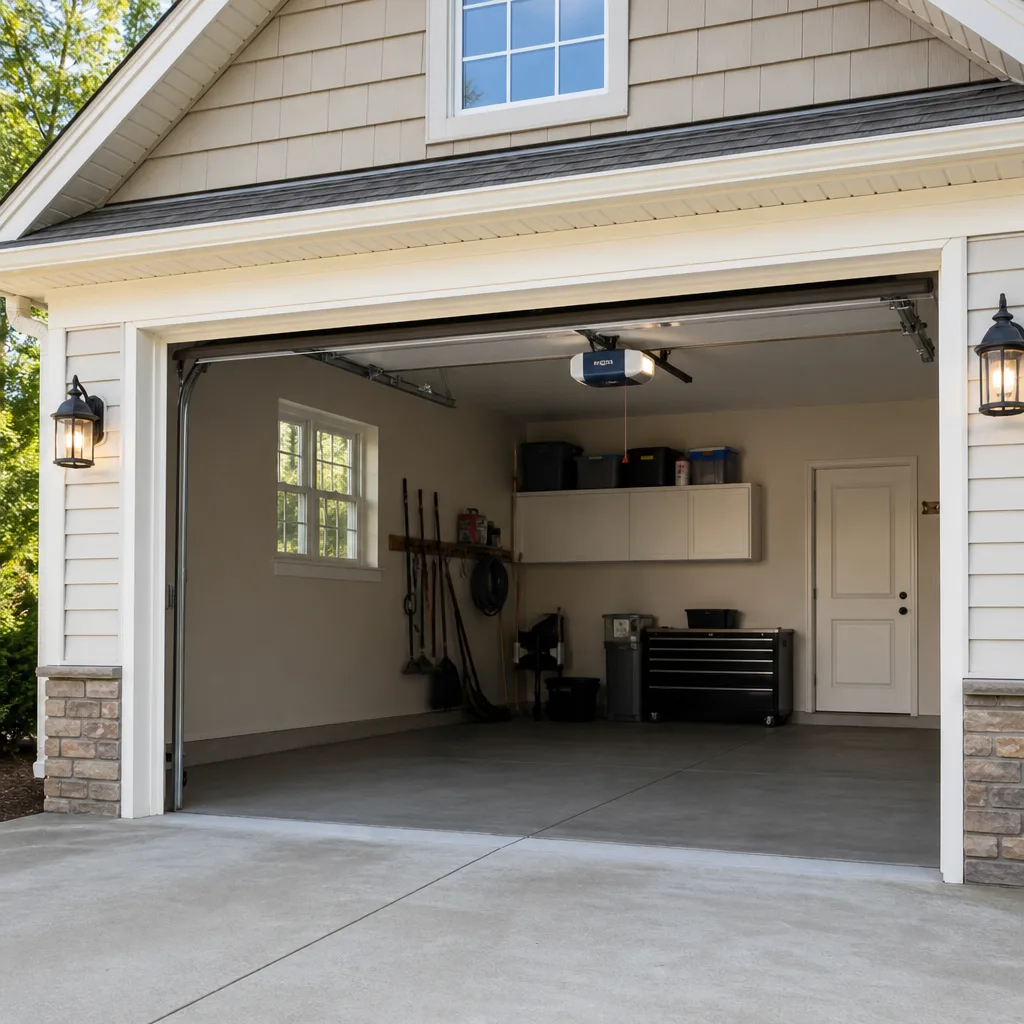
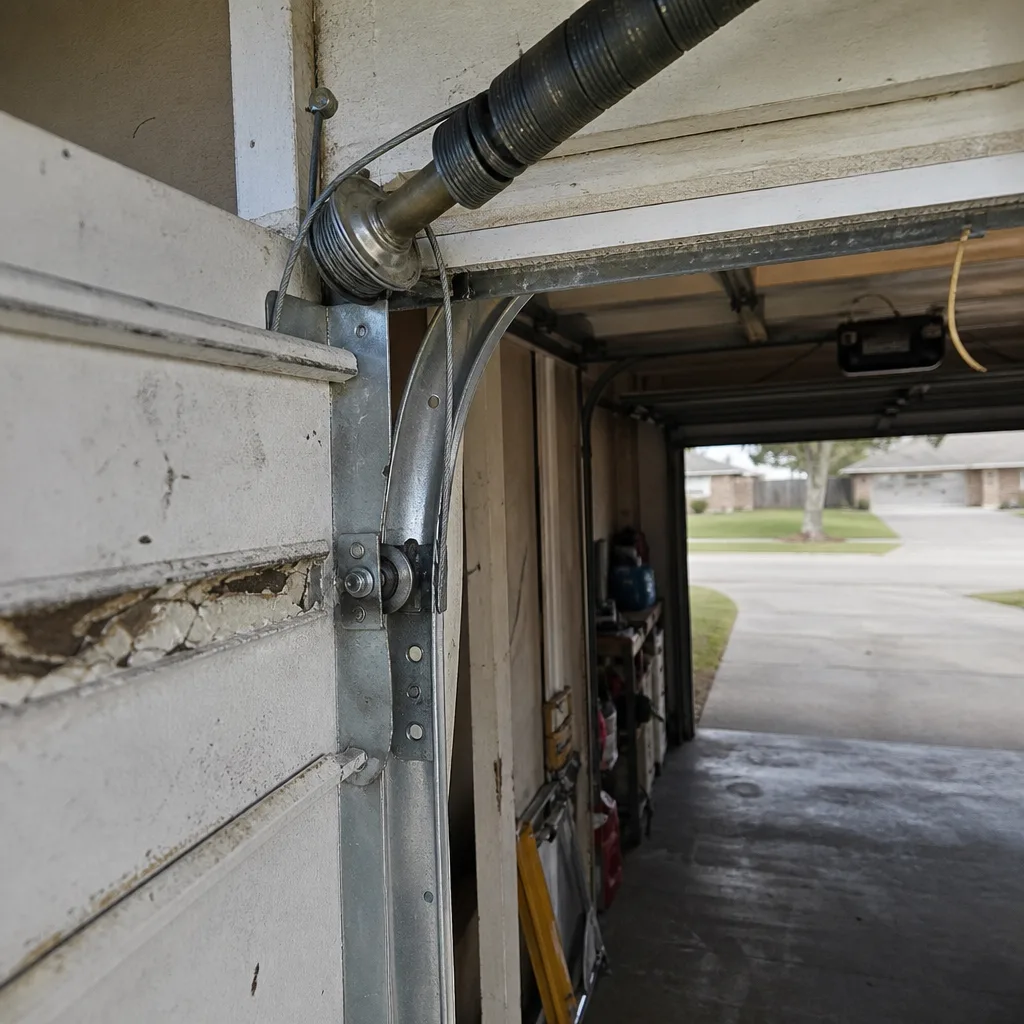 Before
 After
After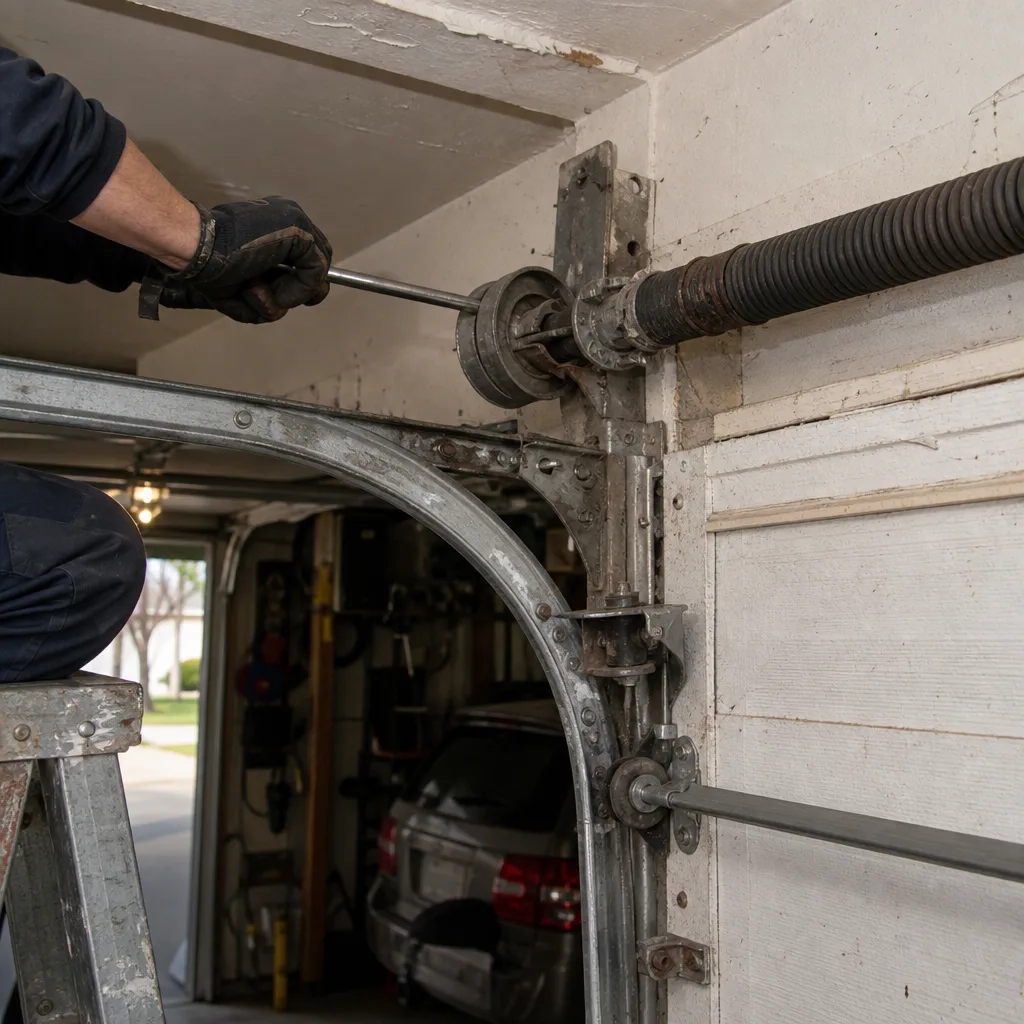 Before
 After
After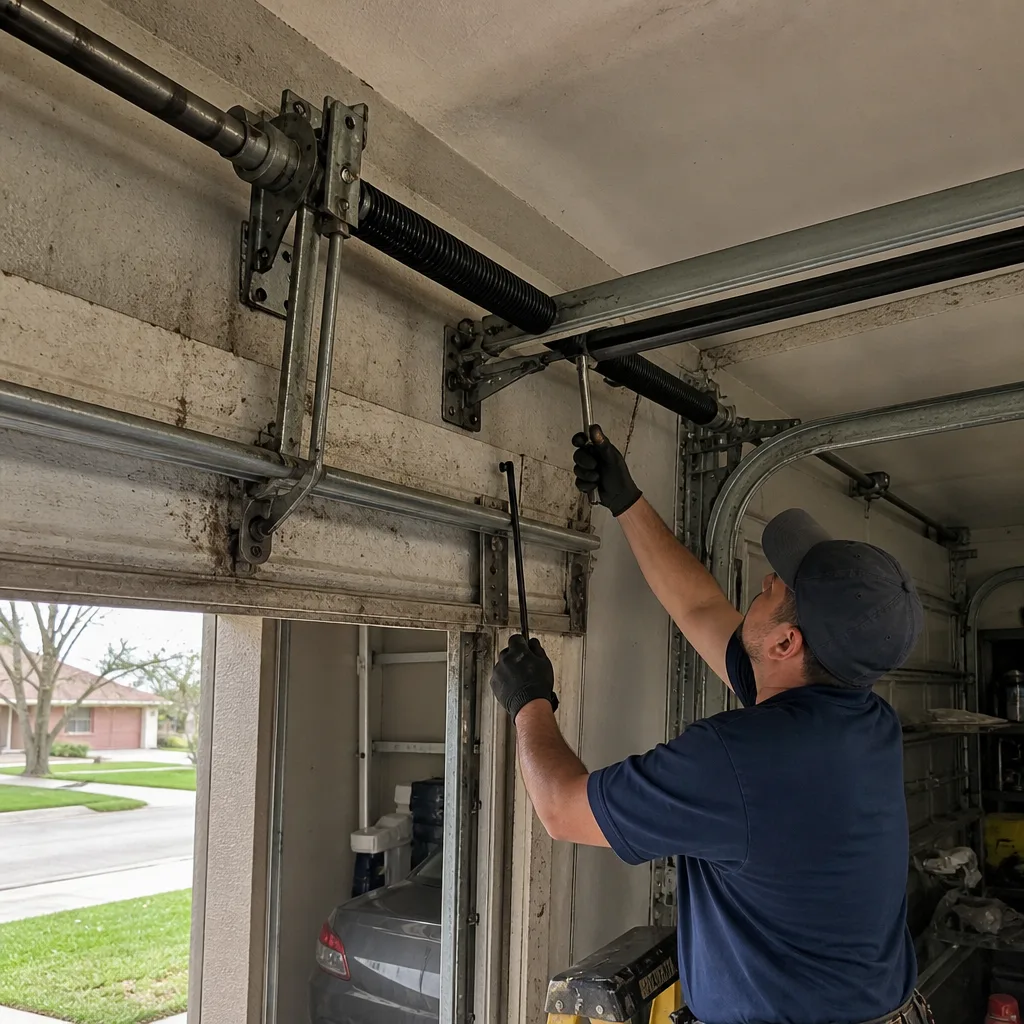 Before
 After
AfterDIY vs Professional Garage Door: The Missouri City Homeowner’s Decision Guide
A torsion spring on a standard 16-foot residential garage door holds between 100 and 300 foot-pounds of torque when fully wound. That’s roughly the stored energy of a loaded truck axle spring, and it’s why professional technicians wind them by hand with solid steel winding bars rather than power tools. The bars must be held manually so the technician can feel the tension change through their palms and forearms, a tactile feedback loop that no drill can replicate. In Missouri City, where summer humidity spikes above 90% and winter northers drop temperatures fast, that spring metal fatigues faster than in drier climates, making the replacement decision more urgent and more dangerous for homeowners who underestimate what’s coiled above their cars. This guide draws the line between safe homeowner maintenance and work that requires professional handling, not by asking how handy you are, but by examining which tasks carry stored-energy risks that skill level cannot fully mitigate.
Quick Answer
Most Missouri City homeowners can safely handle weatherstrip replacement, sensor realignment, lubrication, remote programming, and cosmetic touch-ups. Torsion spring replacement, cable work, track realignment on loaded doors, and any repair involving the counterbalance system should be left to professionals due to lethal stored-energy risks. Opener replacement sits in the middle: DIY saves money upfront if you match the unit to your door’s weight and spring system, but a mismatched opener typically shortens spring life and costs more within three years.
Table of Contents
- The Physics That Makes Some Garage Door Work Dangerous
- Safe DIY Tasks for Missouri City Homeowners
- Tasks You Should Never Attempt Yourself
- The Cost Math on Opener Replacement: DIY vs Professional
- What to Document Before You Touch Anything
- Missouri City Climate and Code Factors
- Common Mistakes to Avoid
- When to Call a Professional
- Frequently Asked Questions
- The Bottom Line
 Before
 After
AfterThe Physics That Makes Some Garage Door Work Dangerous
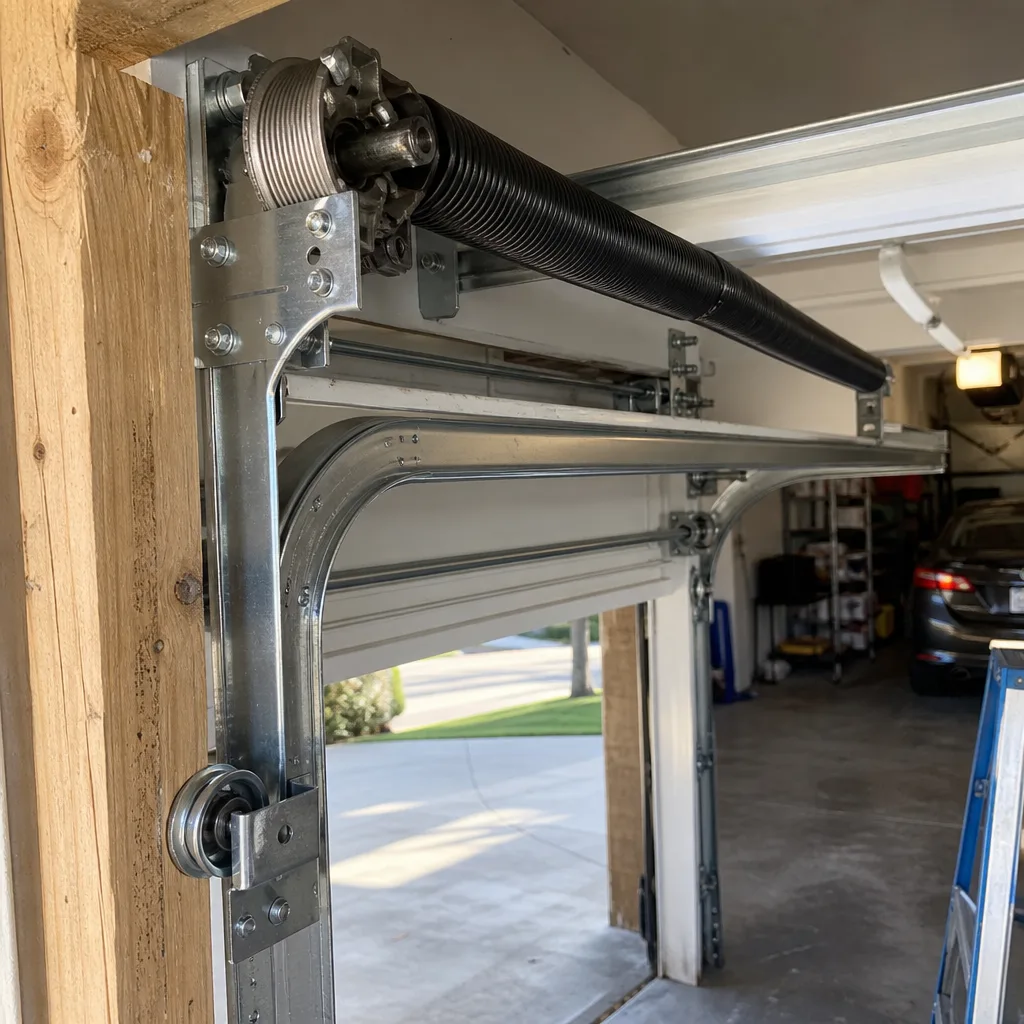
The danger in garage door work isn’t about falling off a ladder or pinching a finger. Those happen, but they’re manageable risks. The categorical difference lies in stored mechanical energy, specifically in the torsion spring system that counterbalances your door’s weight.
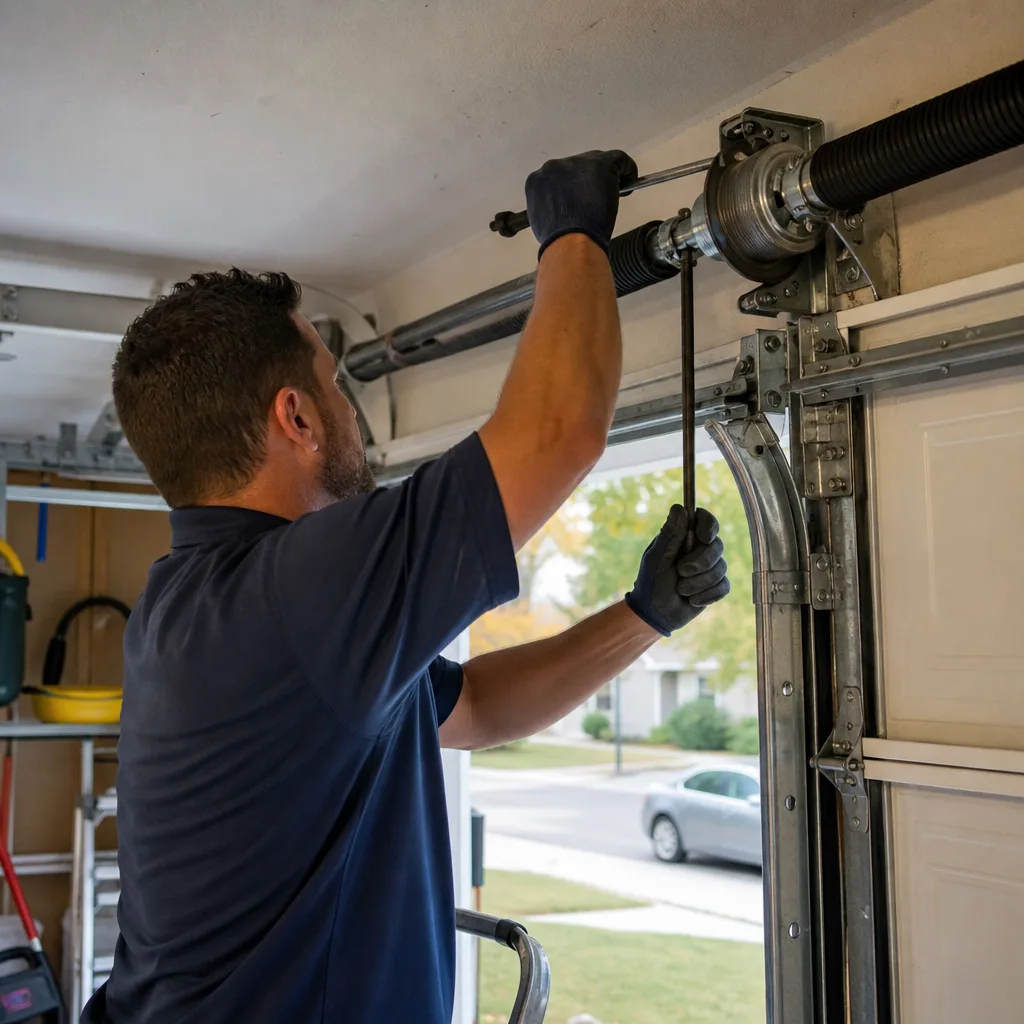
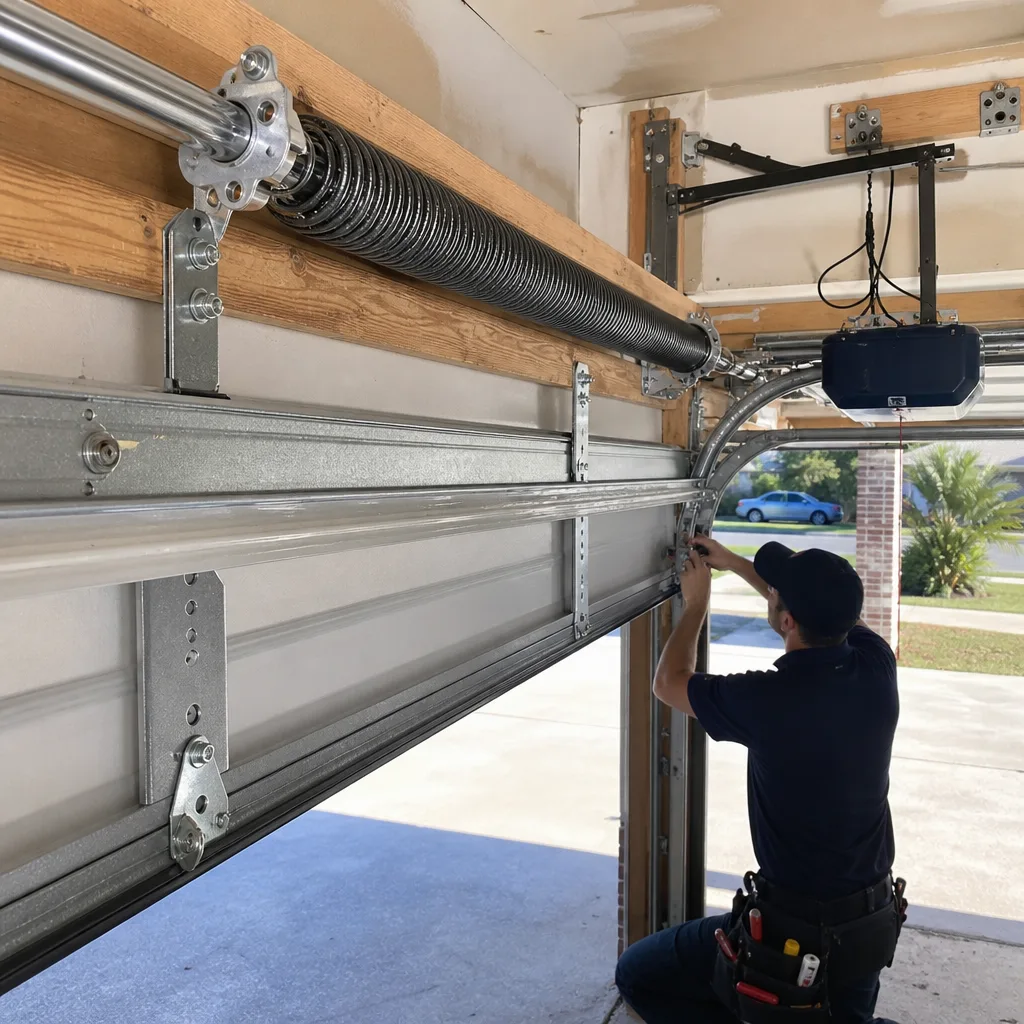
Here’s how it works. Your garage door weighs between 150 and 400 pounds depending on size, material, and insulation. The torsion spring, mounted on a steel shaft above the door opening, is wound tight to create torque that offsets that weight. When the door is closed, the spring is fully wound and holding maximum energy. When the door opens, the spring unwinds, releasing energy to help lift the door. The opener doesn’t do the heavy lifting; it merely initiates and guides the movement. The spring does the work.
That energy doesn’t disappear if the spring breaks. It releases instantly, often with a sound like a gunshot. A winding bar inserted into a cone at the wrong angle can slip, and the bar becomes a projectile. We’ve seen winding bars punch through drywall, shatter car windshields in Missouri City garages, and cause injuries that required emergency surgery. The risk isn’t that you might make a mistake; it’s that the margin for error is measured in degrees of bar angle, and the consequence of missing that margin is catastrophic.
Cable replacement carries similar stored-energy risk. The cables transfer the spring’s torque to the bottom corners of the door. If you disconnect a cable under tension, the door can drop or shift, and the remaining cable can whip. Track realignment on a loaded door is equally hazardous because you’re working with the full weight of the door suspended on compromised hardware.
This is why we draw the line at mechanical energy, not skill level. A brilliant engineer with steady hands and excellent tools still cannot feel torque through a power drill. The human hand on a steel bar is the safety mechanism, and that’s not available to a homeowner who watched a tutorial and bought a winding kit online.
Safe DIY Tasks for Missouri City Homeowners
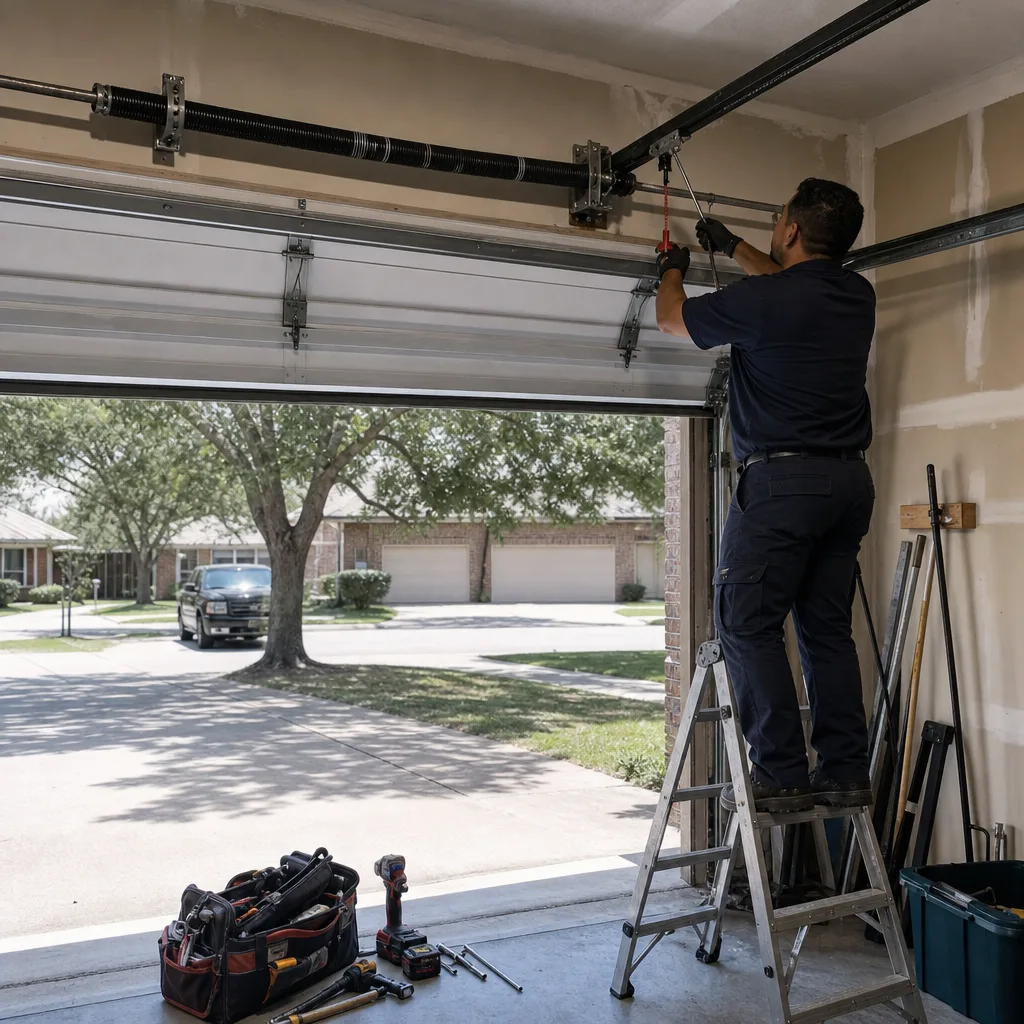
Not all garage door work involves stored energy. Several maintenance and minor repair tasks are genuinely low-risk and well-suited to an informed homeowner. These are the tasks we encourage Missouri City residents to handle themselves, both to save money and to become familiar with their system’s normal operation. For more guidance, see our Garage Door Repair Maintenance Checklist for Missouri City Homeowners.
Bottom Weatherstrip Replacement
The rubber or vinyl seal at the bottom of your door deteriorates in Missouri City’s heat and UV exposure, typically lasting 3-5 years. Replacement requires no tools beyond a utility knife and possibly a pry bar. Slide the old seal out of the retainer channel, measure and cut the new seal to length, and slide it in. The door should be closed and disengaged from the opener (pull the red emergency release cord) so you can work at ground level. No spring tension is involved.
Sensor Realignment
Photo-eye sensors sit 4-6 inches above the floor on both sides of the door track. If your door reverses immediately when closing, or refuses to close and the opener light flashes, the sensors are likely misaligned. Clean the lenses with a soft cloth, check that both LED indicator lights are solid (not blinking), and gently adjust the brackets until they face each other directly. In Missouri City, where clay soil shifts with moisture changes, we’ve seen sensor brackets drift out of alignment after heavy rains.
Lubrication
Annual lubrication extends component life significantly. Use a silicone-based spray or white lithium grease on the hinges, rollers, and bearing plates. Do not lubricate the track itself; the rollers need friction to roll rather than slide. Avoid WD-40 for this task; it’s a solvent, not a lubricant, and attracts dust. Apply sparingly, wipe excess, and operate the door several times to distribute.
Remote Programming and Keypad Setup
Most modern openers, including Chamberlain and Genie models common in Missouri City homes built 2015-2025, use a simple learn-button process. Press the learn button on the opener motor housing, then press the button on your remote within 30 seconds. For multi-button remotes, each button can control a different opener or gate. Keypads follow the same learn-button sequence with a PIN entry step. Consult your specific model manual for the button location, which varies by manufacturer and year.
Panel Paint Touch-Up
Steel door panels develop scratches and chips that invite rust in Missouri City’s humid climate. Sand the affected area to bare metal, apply rust-inhibiting primer, and finish with exterior-grade paint matched to your door color. For Clopay and Amarr doors, color codes are printed on the inside edge of the door or available through the manufacturer’s dealer network.
Key Takeaways for Safe DIY:
- Work with the door closed and opener disengaged whenever possible
- Never touch the torsion spring, cables, or bottom brackets
- If a task requires the door to be open, use locking pliers on the track as a safety catch
- Stop immediately if you encounter resistance you didn’t expect
Tasks You Should Never Attempt Yourself
These tasks carry stored-energy risks that no amount of preparation, intelligence, or equipment fully eliminates. We state this categorically, not as a liability disclaimer, but because the physics don’t negotiate.
Torsion Spring Replacement
We’ve covered the energy storage above. Additional factors make this worse for DIY attempts: the spring must be matched precisely to door weight, track radius, and drum size; wound springs require specific turns based on door height; and the set screws on the winding cone must be torqued to specification. A spring that’s under-wound strains the opener and fails prematurely. A spring that’s over-wound is a bomb. In Missouri City, we replace springs that failed because a previous DIY attempt used the wrong wire diameter, typically 0.234-inch when 0.250-inch was required.
Cable Replacement
Cables run from the bottom bracket, up the track, and wrap around the cable drum at the end of the torsion shaft. To replace a cable, the door must be fully open (where spring tension is lowest but still present), the spring must be unwound, the cable unwrapped from the drum, and the new cable tension-matched to its pair. An unbalanced door strains the opener, wears rollers unevenly, and can slip from the track. The bottom brackets are under spring tension even when the door is open; never remove the bolts connecting cable to bracket without proper winding bars in place.
Track Realignment on a Loaded Door
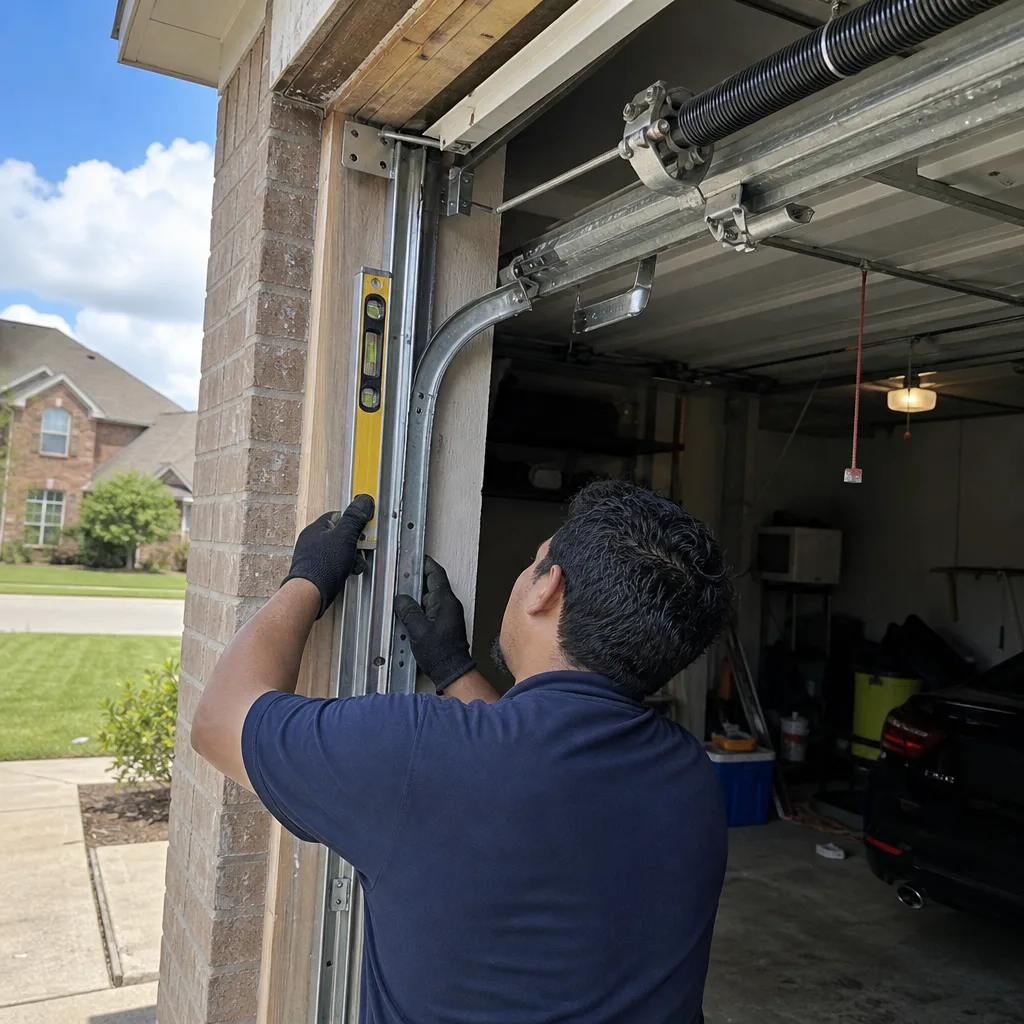
Track sections can bend from impact or loosen from vibration. Realigning track with the door suspended is dangerous because the rollers bear the full door weight at the point of misalignment. The proper procedure requires supporting the door with clamps or a jack, which most homeowners don’t have, then adjusting track with the door weight removed. We’ve responded to emergency calls in Missouri City’s Sienna Plantation and Lake Olympia neighborhoods where a door jumped track during attempted DIY realignment, trapping a vehicle inside.
Bottom Bracket Replacement
The bottom brackets connect the lifting cables to the door. They’re under constant spring tension and are the most dangerous point on the entire system. Even professional technicians approach bottom brackets with winding bars inserted and the door properly supported. This is not a learning opportunity.
Spring Conversion (Extension to Torsion)
Some older Missouri City homes, particularly in established neighborhoods like Quail Valley, still have extension spring systems mounted above the horizontal tracks. Converting to torsion springs is a significant upgrade for safety and balance, but it requires engineering the header mounting, calculating spring specifications, and handling both spring systems during transition. The complexity and dual energy sources make this exclusively professional work.
The Cost Math on Opener Replacement: DIY vs Professional
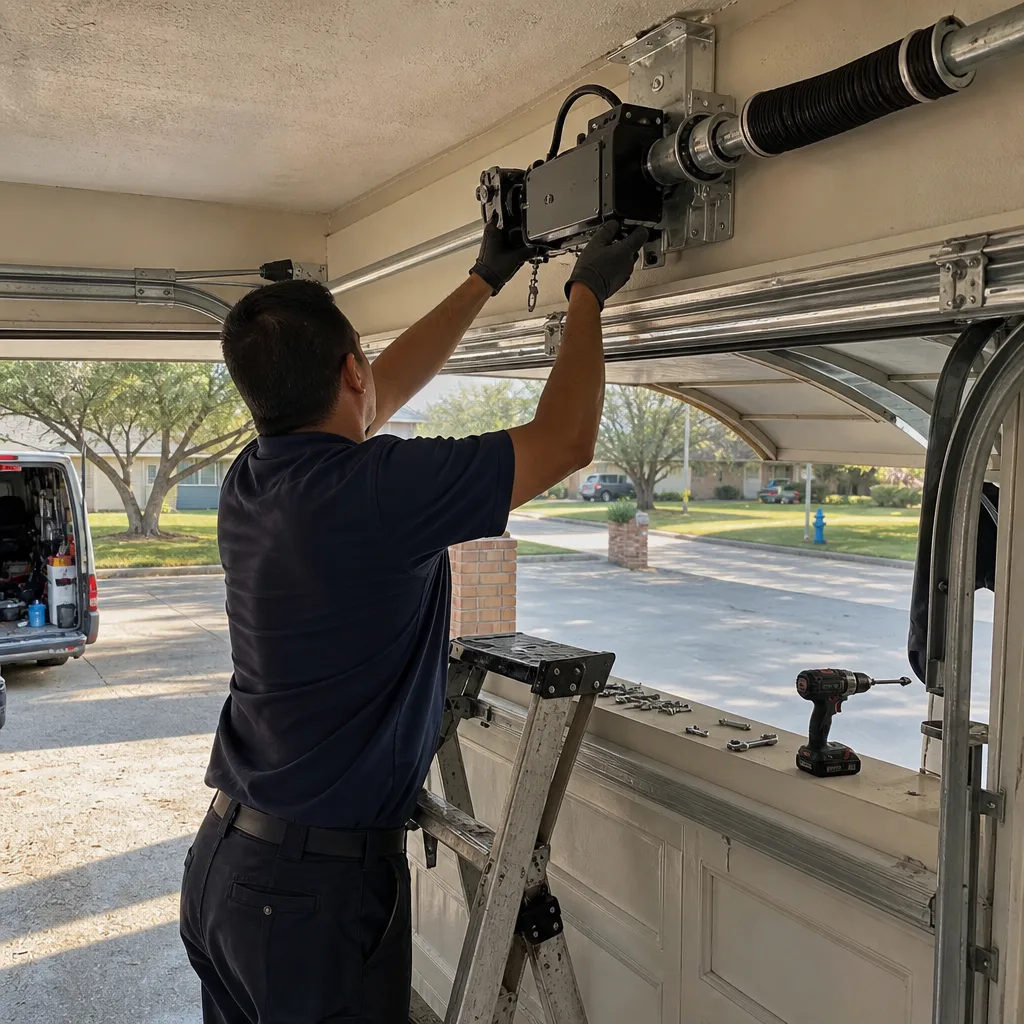
Opener replacement is the borderline case where DIY can save real money, or cost substantially more over time. The decision hinges on matching, not just installing.
When DIY Saves Money
A straightforward swap of a like-for-like opener on a properly balanced door is genuinely DIY-appropriate for mechanically inclined homeowners. If your existing ½-horsepower chain-drive opener failed after 12-15 years and your door is a standard 16×7 steel non-insulated panel weighing under 150 pounds, a direct replacement with a similar Chamberlain or Genie unit from a home improvement retailer runs $200-350 for the opener plus $50-100 for rail extension or accessories. Installation requires basic tools, a ladder, and 3-4 hours. Total DIY cost: $250-450.
Professional installation of the same unit typically runs $400-650 including opener, with warranty coverage on both parts and labor. The DIY savings here are real: $150-300, assuming nothing goes wrong.
When DIY Costs More Over Time
The hidden cost is mismatch. We’ve documented this repeatedly in Missouri City service records. Common scenarios include:
- Underpowered opener on a heavy door: A ½-horsepower unit on a solid wood or heavily insulated door forces the opener to strain, burning out the motor or logic board within 2-3 years. The replacement then requires a heavier unit plus possible electrical upgrade.
- Wrong drive type for door weight: Belt drives are quieter but have lower torque tolerance than chain drives. Installing a belt drive on an improperly balanced heavy door accelerates wear on both opener and spring system.
- Mismatched rail length: Standard 7-foot rails on an 8-foot door, or vice versa, causes limit switch errors and unsafe closing behavior.
- Ignoring spring condition: A new opener on worn springs works harder and fails faster. Professional installation includes spring assessment; DIY typically doesn’t.
The three-year cost comparison often reverses. A DIY install that saves $200 initially, followed by premature opener failure and spring replacement, can exceed $800 by year three. Professional installation that includes proper matching, spring evaluation, and warranty coverage often costs less over the same period.
Our recommendation: if your door is standard weight, your existing opener was properly matched, and you’re doing a direct replacement, DIY is reasonable. If your door is solid wood, custom oversized, or you’re upgrading features (battery backup, smart connectivity, wall-mount jackshaft), professional specification prevents expensive mismatch. Garage Door Opener Repair & Installation in Missouri City includes written specification of the matched unit before any work starts, per Clause 1 of The Haven Standard.
What to Document Before You Touch Anything
The paper trail that defines Servo’s work applies to homeowners too. If you attempt any DIY maintenance and later need professional service, your documentation determines whether the technician can diagnose efficiently or must reverse-engineer unknown changes.
- Photograph the system before disassembly. Take clear images of cable routing, spring orientation, bracket positions, and wire connections. Date the photos.
- Record model numbers. Note the opener manufacturer, model, and date of manufacture (on the motor housing sticker); door manufacturer and any stamped size information on the interior panel edge; spring wire diameter, inner diameter, and length if visible and accessible.
- Note the symptom sequence. “Door began reversing two weeks ago, then stopped responding to remotes yesterday” is more useful than “door broken.”
- Preserve replaced parts. If you swap a remote, sensor, or weatherstrip, keep the old component labeled with date. It may clarify whether the part failed or was misdiagnosed.
- Document what you changed and when. A simple note: “Replaced bottom weatherstrip 3/15/2025. Lubricated hinges and rollers 3/15/2025. No other work.”
When Servo technicians arrive after DIY work, we review this documentation before touching the system. Clause 4 of The Haven Standard, the founding rule that the customer sees the failed part before anyone quotes a replacement, applies equally to understanding what preceded our arrival. A clear paper trail saves diagnostic time, which saves you money.
Missouri City Climate and Code Factors
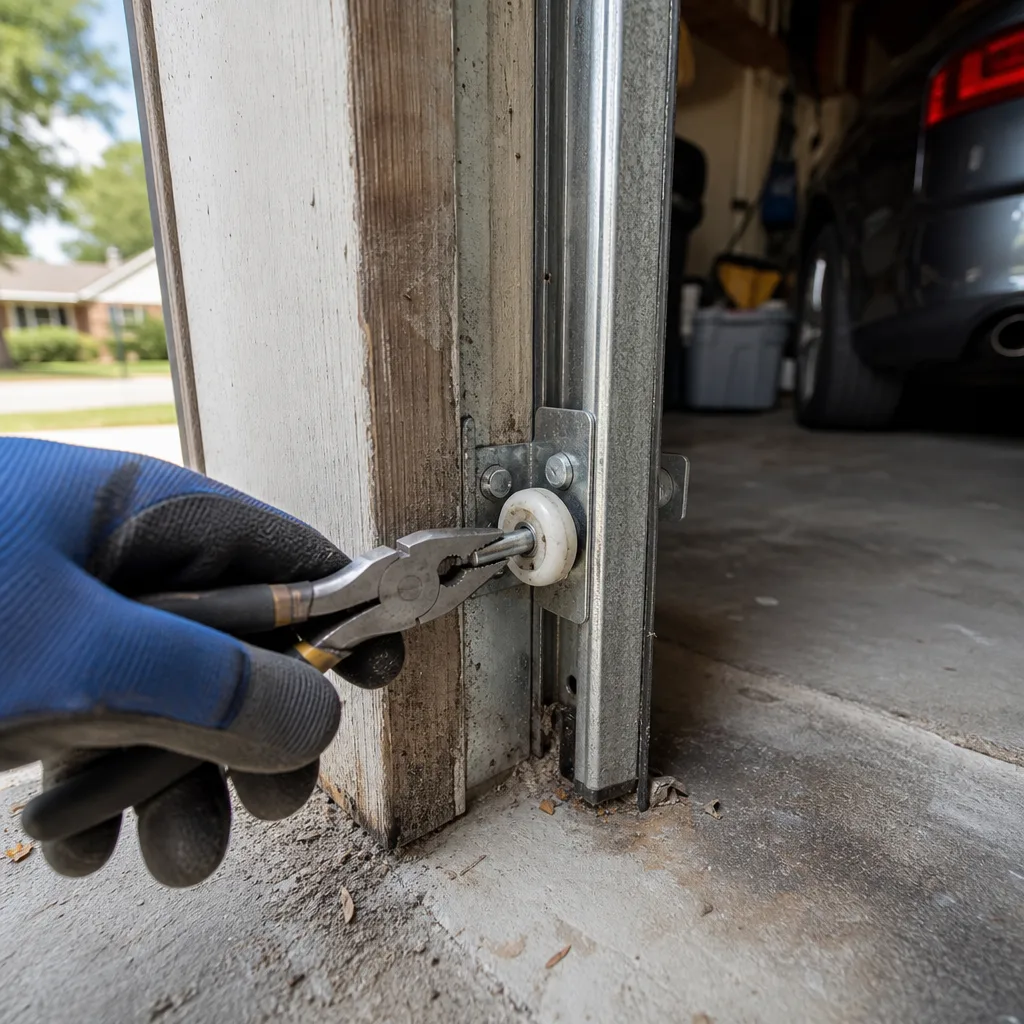
Local conditions affect both DIY feasibility and professional service needs in ways that generic guides miss.
Humidity and Corrosion
Missouri City’s annual humidity averages 75%, with summer peaks above 90%. Steel components, particularly bottom brackets, cable drums, and bearing plates, corrode faster than in drier Texas markets like El Paso or Amarillo. Lubrication intervals should be every 8-10 months rather than annual. We’ve replaced cable drums in Missouri City’s Lakes of Brightwater and Riverstone communities that seized due to corrosion after just 4 years, where 6-8 years would be typical in drier climates.
Soil Movement and Foundation Settlement
The gumbo clay common in Fort Bend County expands and contracts dramatically with moisture. After heavy rains, we’ve seen garage door frames shift enough to bind doors or throw tracks out of plumb. This isn’t a component failure; it’s a structural adjustment. DIY track tweaking in these conditions often compounds the problem by masking the underlying settlement. Professional assessment includes checking whether the issue is track, frame, or foundation.
Wind Load Requirements
Missouri City lies in a 120-mph wind zone per Texas building codes. Garage doors must have proper wind load certification, particularly in newer developments with stricter HOA requirements. If you’re considering DIY panel replacement or full door replacement, verify that your chosen product carries the appropriate wind load label for your specific address. Some Missouri City subdivisions, particularly those built after Hurricane Ike, require documentation of wind load rating for any exterior modification.
Permit Requirements
Garage door replacement in Missouri City typically requires a building permit if the door size changes or if structural modification to the opening is involved. For full details, read Garage Door Permits, Codes & Inspections in TX: What You Need to Know. Simple like-for-like replacement on existing framing usually does not. However, if your DIY project involves widening the opening, adding windows, or converting to a different door type (carriage house style with different hardware loads), check with the City of Missouri City Building Division before starting. Unpermitted structural work can complicate future home sales and insurance claims.
Common Mistakes to Avoid
- Using the wrong spring wire diameter. A spring that’s close enough isn’t close enough. Wire diameter differences of 0.016 inch (one wire gauge) change the torque output by approximately 10%. We’ve found 0.234-inch springs on doors spec’d for 0.250-inch in Missouri City’s Meadowcreek and Colony Lakes neighborhoods, installed by homeowners who matched length and diameter but missed wire size.
- Lubricating the track. Rollers need to roll, not slide. Oil or grease on the track causes flat spots on nylon rollers and attracts abrasive dust. Lubricate bearings and hinges only.
- Adjusting force settings instead of fixing the underlying problem. When a door reverses or strains, increasing the opener’s force setting masks a balance or track issue. The door may then close with enough force to injure someone or damage property. Force settings should never exceed what’s needed for smooth operation.
- Ignoring the door balance test. Disconnect the opener and lift the door manually to waist height. It should stay there, neither rising nor falling. If it drifts, the spring system is out of balance, and the opener is compensating. Installing a new opener on an unbalanced door guarantees premature failure.
- Reusing old hardware on a new door. Hinges, rollers, and bearings have finite cycles. A new Clopay or Amarr door on worn 10-year-old hardware wears the hardware faster and may void the door warranty. Budget for complete hardware replacement with any new door installation.
- Working alone on any task requiring the door to be open. Even safe DIY tasks become dangerous without someone to steady a ladder, call for help, or hold a door section. The saved time isn’t worth the risk.
- Buying springs or cables online without verifying specifications. Color-coding for spring wire diameter is not universal between manufacturers. A red paint mark means one thing from one supplier, another from a different source. Always measure and verify, never assume.
When to Call a Professional
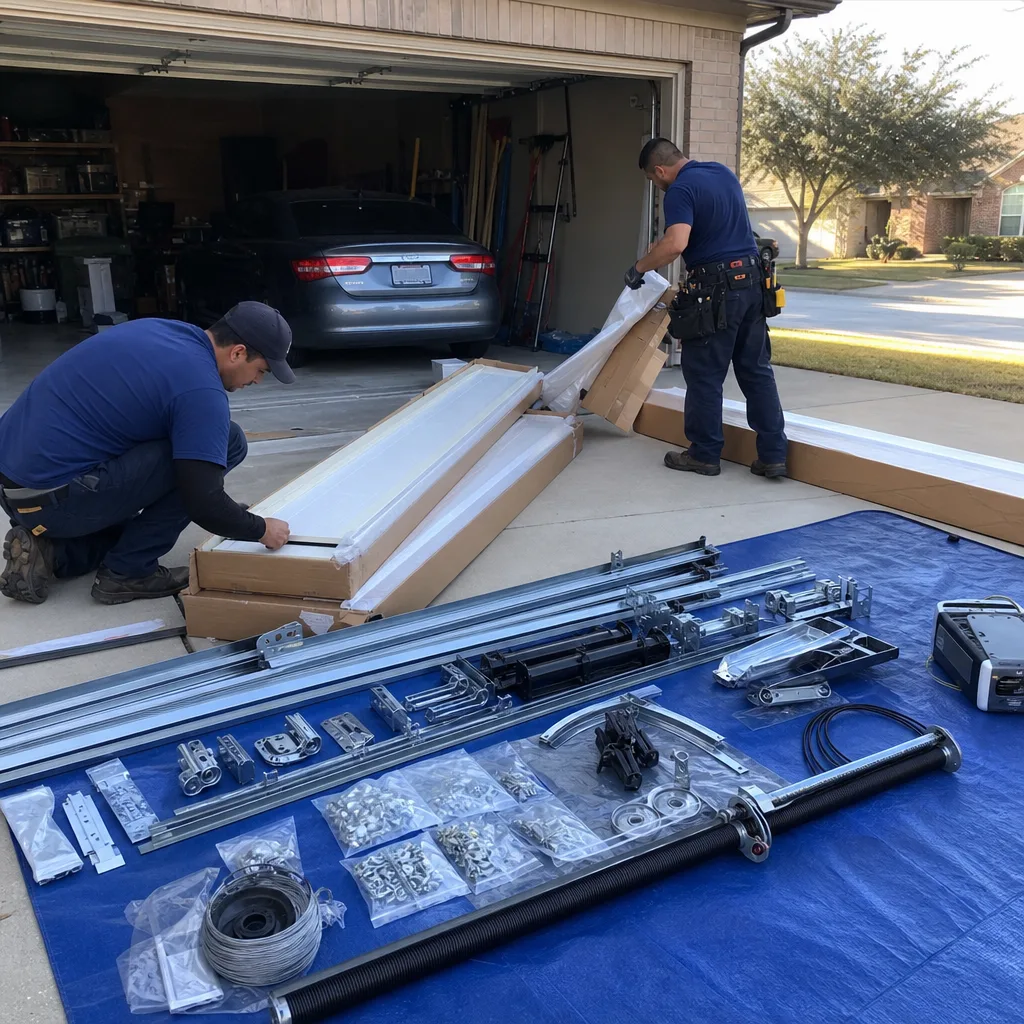
Call a professional when the task involves stored mechanical energy, when the symptom suggests structural rather than component issues, or when your documentation shows a pattern of repeated failures that indicates systemic mismatch. In Missouri City, we also recommend professional assessment after any foundation work, significant soil saturation event, or if your door is original to a home built before 2000 and has never had spring replacement.
Servo Garage Doors Missouri City offers free estimates in Missouri City. Our technicians arrive with a documented photo record process, a flat written price before any work starts per Clause 1 of The Haven Standard, and the 365-Day Done Right Promise backing every repair. Call (346) 456-5565 to schedule. If you have a written estimate from another company, our Free Second Opinion applies, no coupon required.
Frequently Asked Questions
Torsion spring replacement in Missouri City typically ranges from $180 to $340 for a standard residential door, including the spring, winding, and balance adjustment. For a deeper cost analysis, see our Garage Door Cost Breakdown: The Missouri City Homeowner’s Reference for 2026. The price varies with door size, spring specification (wire diameter, inner diameter, and length), and whether one or both springs need replacement. We quote a flat, written price before any work starts, per Clause 1 of The Haven Standard. Call (346) 456-5565 for an exact quote on your specific door; estimates are free.
If your door has two torsion springs, replace both. Springs installed together have matched cycle life; when one breaks, the other has endured identical stress and will fail soon. Replacing one creates an imbalance that strains the opener and wears hardware unevenly. The small savings of single replacement is erased by the callback and additional labor of a second repair within months. We warranty spring pairs as a system, not individually, for this reason.
No. Our written price, delivered before any work starts, is the price you pay. The only exception is if you request additional work after receiving the initial scope. If inspection reveals a condition we couldn’t anticipate (hidden structural damage, for example), we document it, explain the finding, and provide a revised written scope before proceeding. You approve every dollar. This is Clause 1 of The Haven Standard, non-negotiable since 2015.
Standard torsion springs are rated for 10,000 cycles (one open and one close). At four cycles daily, that’s roughly 7 years. In Missouri City’s humidity, corrosion accelerates fatigue at the spring ends where stress concentrates. We’ve observed 15-20% shorter lifespan in homes within 2 miles of water features or with poor garage ventilation. High-cycle springs rated at 25,000 or 50,000 cycles are available and cost-effective for doors in heavy use.
Yes. Our Missouri City service vehicles stock torsion springs in common wire diameters from 0.207 to 0.283 inch, cables, rollers, hinges, weatherstrip, and logic boards for major brands including Chamberlain, Genie, LiftMaster, and Craftsman. For Clopay and Amarr door-specific components, we typically source within 24 hours. Emergency calls receive priority dispatch with a named technician and on-the-way text.
Extension springs stretch along the horizontal tracks and store energy in extension; torsion springs twist on a shaft above the door and store energy in torque. Torsion systems are safer (the spring is contained on the shaft if it breaks), provide smoother operation, and allow finer balance adjustment. Conversion from extension to torsion is a significant upgrade we recommend for any Missouri City home with an extension system, but it is not DIY-appropriate. The engineering of spring specification, header mounting, and dual-system handling during transition requires professional equipment and training.
The Bottom Line
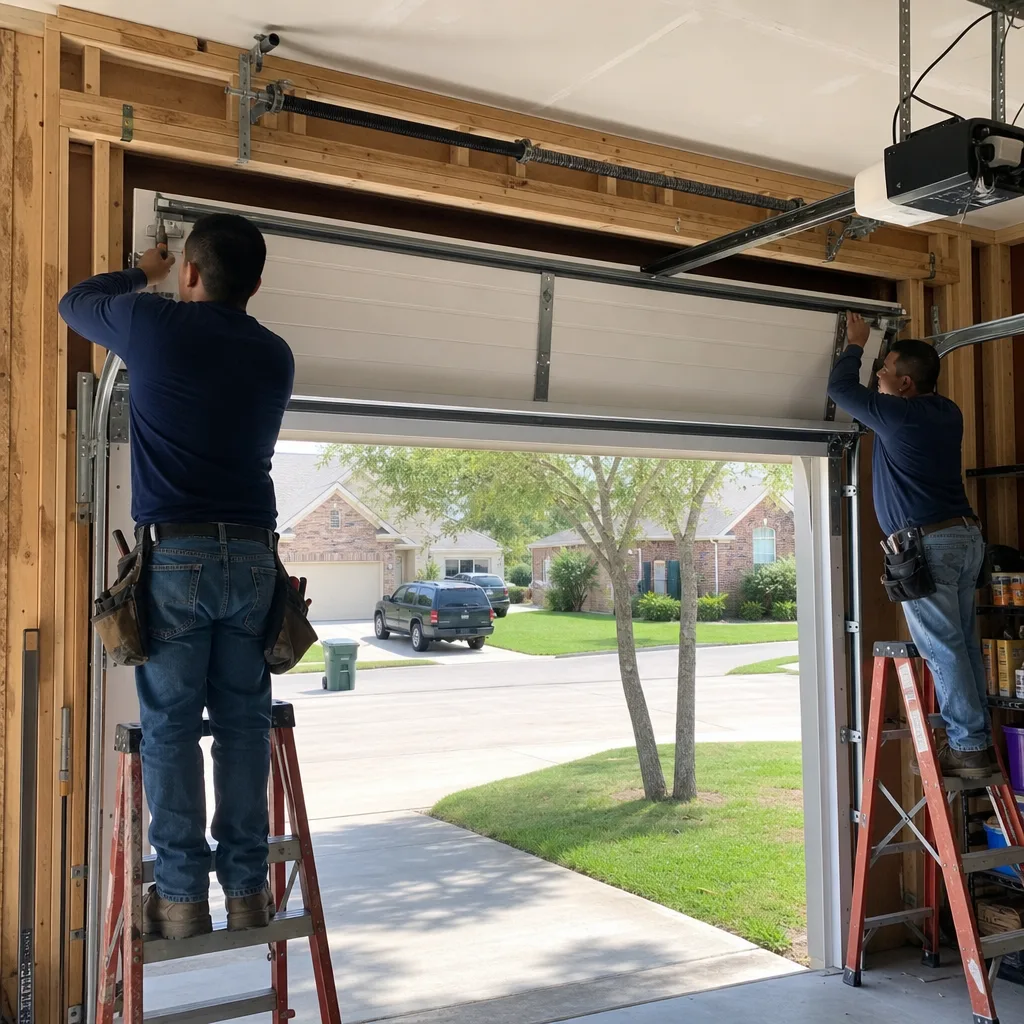
The DIY versus professional question for garage doors resolves at the physics, not the personality. Weatherstrip, sensors, lubrication, remotes, and paint are genuinely within reach of informed homeowners. Torsion springs, cables, bottom brackets, and track work on loaded doors carry stored energy that doesn’t care about your skill level or preparation. Opener replacement sits in the middle: DIY saves money when the match is exact, costs more when it’s wrong. Document everything you touch, understand your local climate’s acceleration of wear, and recognize that the technician’s hand on the winding bar is a safety instrument, not a preference. For work across that line, or for a Free Second Opinion on any written estimate, Servo Garage Doors Missouri City home operates under The Haven Standard: written price first, documented record last, and every visit traceable to the founding rule that the customer sees the failed part before anyone quotes a replacement.
Written by Marcus Deller, Owner at Servo Garage Doors Missouri City, serving Missouri City since 2015. Explore more guides & resources on our blog.